
3b) Second legislative area or policies and standards
In this second section you can either explore a second area of legislation (see above) or discuss how you engage with one or more policy issues in your context. Evidence might include evidence of involvement in writing or forming policies, or evidence of engagement with policies, such as justifications for modifications to a course to reflect new policies, a record of how technical standards have been taken into account during system development, and so on.
CMALT 2019
Supporting, Developing, Engaging with and Influencing Policy in Open Education
I was Project Manager for the OER Wales Cymru Inititiative in 2014/15 which was a project set up in response to the Wales Declaration of Intent to become an Open Education Nation. I have continued my interest in Open Education since then and have been secretary of the ALT Open Education Special Interest Group (OESIG) since 2014 and Co-Chair since 2018. The OE SIG remit is to ‘support develop, sustain and influence policy in open education. I, therefore, engage regularly with the members of the OESIG and help promote discussions on policies and practices in relation to open education. 📢CP4 As I am also a member of the Global Graduate OER Network I promote links between the two organisations and highlight activities such as the recent webinar that covered Mara Bordingnon’s PhD work on Open Education Policies and prior to that the European Commission Going Open : Policy Recommendations on Open Education in Europe (Open Edu Policies) .
I have also contributed to a new position statement in relation to Open Education Practice on behalf of Jisc although this is yet to be published.
Engaging with Creative Commons
I identify as being an Open Educational Practitioner and as such try to ensure that materials that I create are openly licenced wherever possible with Creative Commons licencing. As Secretary and Co-Chair of the Open Education Special Interest Group, I regularly engage with Creative Commons policies and standards and try to add a Creative Commons licence to any resources that I create wherever possible. (See evidence section). I think it is a great way to contribute to the culture of freely available resources and enables people to engage with my work. It makes it easier to share and can allow for adaptation which fits with my open values. 📢CP4
Creative Commons Website
Creative Commons License Options
There are six main licence types as can be seen on the Creative Commons website. These give a range of options depending on how you want to share your work and how you hope others will use it going forward. There is also a great Creative Commons Licence Chooser that helps you pick the right licence for your particular work. I have included below some examples of work that I have created or contributed to that are published with a CC Licence. These ones are uploaded to the National Teaching Repository. This is a project that I am fortunate to have been involved with since it’s inception as both a curator and contributor. This is an open access, online searchable database for ‘tried and tested strategies and ideas’ created by Dr Dawne Irving-Bell. More information here 📢CP4
Examples of CC Licenced Work (via NTR)

National Teaching Repository
Contribution to Institutional Policy Recommendations : Australian National Textbook Study
I have provided some sketchnoting resources in relation to institutional policy recommendations with regard to the Australian National Textbook study led by Dr Sarah Lambert. My sketchnotes were used in a number of key presentations and helped to bring this much needed work to a wider audience. These are licensed with a CC Licence CC-BY-SA 📢CP4
An example of a CC remix – Visual Thinkery
As a really great practical example, I’d like to highlight the amazing Visual Thinkery Remixer Machine by Bryan M Mathers which allows visuals to remixed and shared under a CC licence. I love using it, its really easy to do .. it can be found here 💻CP2 📢CP4
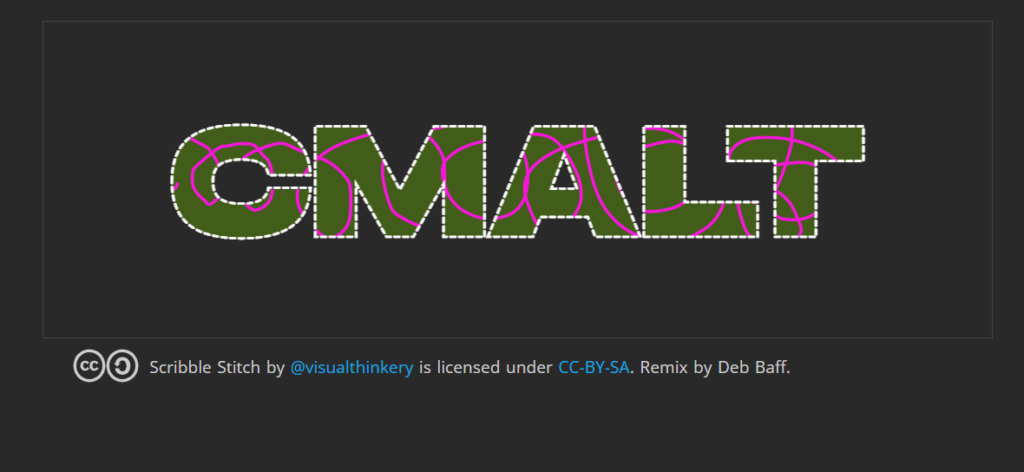
https://remixer.visualthinkery.com/r/TQPKpQMhBmrTwyAO59qO
Ethical Considerations
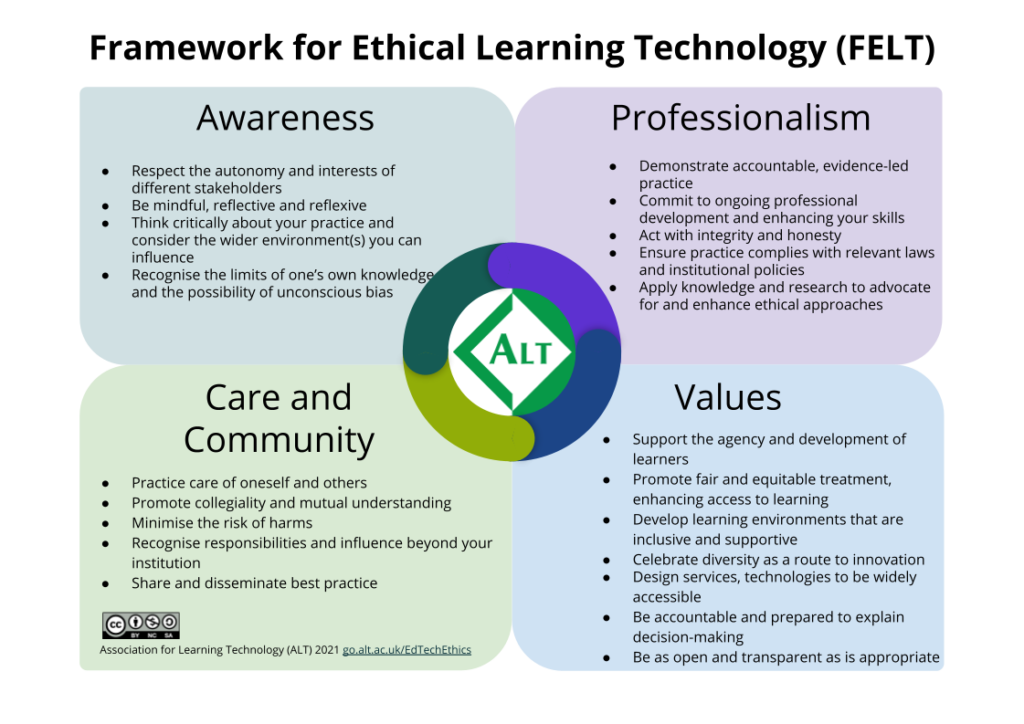
I strongly believe in using technology to support learning, teaching and assessment in an ethical way. While working at ALT I had the opportunity to contribute to the Framework for Ethical Learning Technology ✅Ethics (FELT). I was part of the working group in the early stages and helped to feed in and now engage with this in my context as a Subject Specialist at Jisc. I find the framework really helpful when thinking about my practice. While I would not be so bold as to say that I regularly undertake every one of the aspects outlined in the framework, I aspire to develop learning environments that are as inclusive as possible and am accountable for my actions. I intend to use the FELT Reflective Self-Assessment tool during the next review of the Digital leaders Programme ✅Ethics 💗CP3
| Core Principles & Ethics | Key |
| A commitment to exploring and understanding the interplay between technology and learning | 🔎CP1 |
| A commitment to keep up to date with new technologies | 💻CP2 |
| An empathy with and willingness to learn from colleagues from different backgrounds and specialisms | 💗CP3 |
| A commitment to communicate and disseminate effective practice | 📢CP4 |
| Ethical Considerations | ✅Ethics |


 CP1] A commitment to exploring and understanding the interplay between technology and learning.
 CP2] commitment to keep up to date with new technologies.
 CP4 ] A commitment to communicate and disseminate effective practice
 Ethics] Ethical Considerations
You must be logged in to post a comment.