2b) An understanding of your target learners
Statements should show how you have found out about learners’ needs and the context for their studies, and how you have developed approaches that reflect this. Evidence might include a description of how assistive technologies have been used to support disabled students, how learner feedback has influenced the design of an e-portfolio, how the needs of work-based learners or overseas students have shaped the curriculum, or records of conversations with product analysts, marketing departments or course teams and the resulting plans for your design. Evidence of changed practice, rather than simply the recognition that this is an important area, is required.
CMALT Guidance 2019
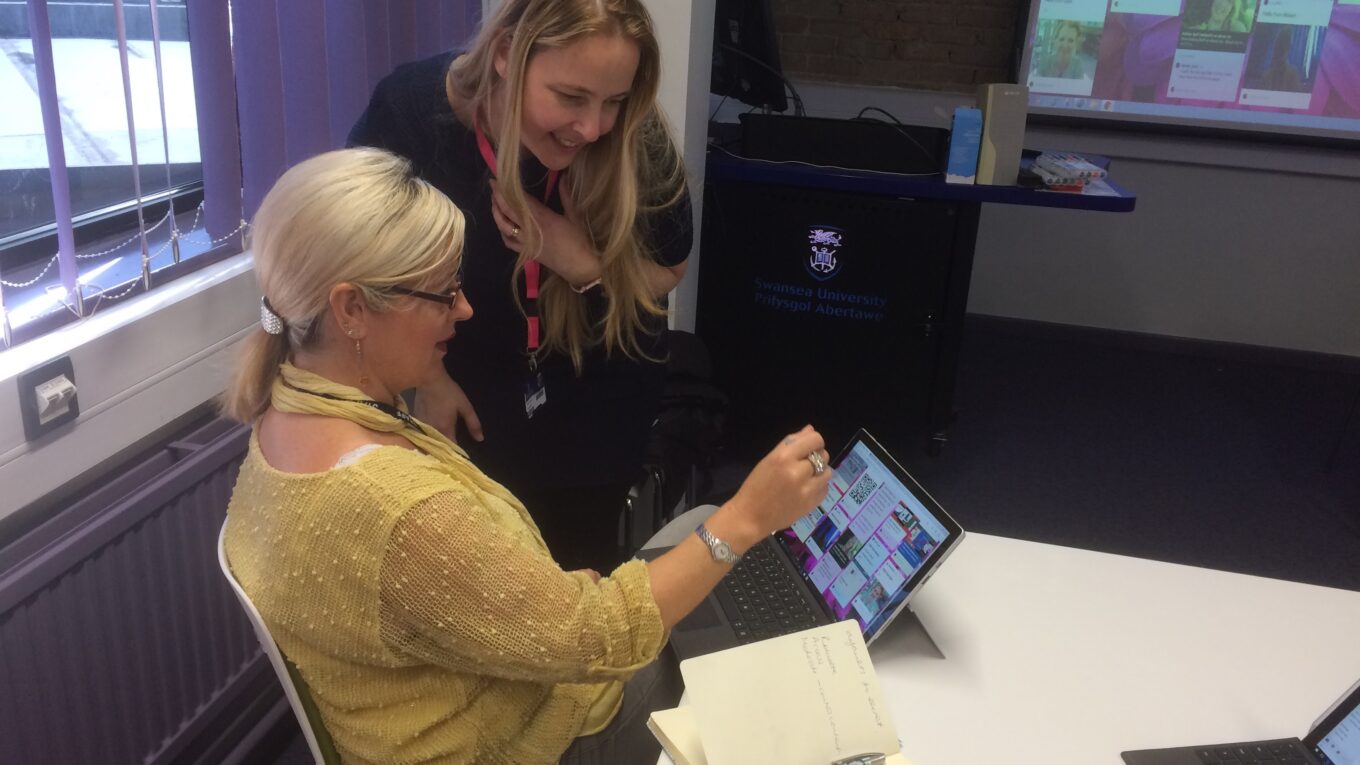
My learners have been a mixture of students, colleagues that I have worked with, community participants and while at ALT and JISC, members. The featured photo above is from when I worked at Swansea University in a workshop that I delivered about using Padlet in your teaching for colleagues ( this is my lovely colleague and friend Rhian ). I always try to connect with learners and find out how best I can help. I also always find that I learn something too ! [💗CP3]
Digital leaders Programme (DLP)
At Jisc my role was brought in to lead the Digital Leaders Programme. This is a collaborative programme where participants are either current leaders in their own institutions or aspiring leaders who work together to explore and reflect on how digital technology is changing the way organisations operate.
The DLP is constantly evolving to keep up to date with the latest good practice in digital technology. The programme is underpinned by four main themes: Mapping digital, Digital Transformation, Understanding your organisation and Becoming a digital leader🔎[CP1]
My role is to manage the programme as whole working with other Subject Specialists across Jisc to deliver content. I am always mindful of the fact that while my role is highly focused on the programme, my colleagues contribute to it alongside their other duties. I, therefore, do my best to be understanding and take into account their other work when setting deadlines etc as I have input into the design and structure of all the themes and sessions that we run. [💗CP3].I work with colleagues to deliver the sessions which ordinarily run as an in-person event as well as an online programme. I have been in post for just over a year and to date, we have not actually run an in-person event so my involvement has been related to the online provision.
The programme is delivered over eight sessions of two hours each with synchronous activities that are completed in groups and additional asynchronous tasks that are undertaken individually. Jisc does not have a VLE as such and therefore we use Microsoft Teams as a course environment. My specific input to the programme has been to redesign the Teams environment to improve the learner experience, develop processes, activities and communication channels to facilitate induction and orientation and to redesign the associated Open Digital Badge suite for the programme.
Redesigning the Teams Environment
I developed new channels and specific tabs within the Teams environment and suggested reducing the number of activities that they were asked to do. I redesigned the look and feel to make the layout simpler and clearly signposted the orientation activities. This meant that learners were able to find their way around and undertake the induction activities more easily. Drawing on my previous experiences, I set up an activity which asked the participants to introduce themselves on the Teams channel so they could start to get to know each other and develop a sense of community. This had the added benefit that it would mean that we would also find out more about our participants.
As such they come to the programme with different backgrounds and areas of interest and have different needs and requirements. This is often noticed for example when using the collaborative whiteboard that we use on the programme, Miro. As I review and revise the programme after each cohort, I am able to make small incremental improvements as we are going along. One thing I noticed was that while some participants are quite happy to experiment with using the Miro board as the course progresses, others are more hesitant and this can sometimes impede their progress. This is particularly crucial as we use Miro as a collaborative journal that all participants can see. It becomes apparent who is finding it easy or difficult very early on in the programme as the journals start to become populated.
I also provided some bite-size resources for people to start to get to grips with using Miro, a collaborative whiteboard tool that we use on the programme for both some of the sessions and also as a learning journal. The changes made can be seen in the slide deck below
Direct Link to Digital Leader Programme Teams Redesign Slide Deck
Open Digital Badges
The DLP offers three different types of open digital badges which are offered through credly. As part of my work in reviewing the programme, it occurred to me that there would be a benefit from reviewing the existing criteria and making this clearer for participants. This in my view would help the take up of the badges and provide a better experience all round. I suggested this to my line manager and was given the go ahead. The PDF below shows the revised criteria and new page that I created for the Teams environment.
Reflection
There were a number of key issues that I wanted to address when I started working on the DLP. Although there were already some induction activities that learners undertook, I noticed that not all of the activities were undertaken and this meant that not everyone was on the same page on starting the programme. I spoke to participants on the programme and them to share their experiences so that I could improve things for future cohorts.
I used the feedback from participants to guide my thoughts and drew on my previous practical experience at ALT, Swansea and the University of South Wales together with helpful guidance from the literature. I always draw heavily from Gilly Salmon’s work as I undertook a course based on this (E-Moderating Building Student Centered Online Communities) as I find this gives me a useful theoretical framework to build upon. I also drew from the Community of Practice literature from Etienne and Beverley Wenger-Trayner. I felt this was really critical to establishing a sense of belonging and encouraging shared learning which in due course would pave the way for participants from the programme becoming part of our Jisc communities.
When I first started at Jisc I was new to using Miro myself so I have been able to really put myself in the shoes of my learners. [🔎CP1] undertook several Miro Academy short courses to upskill myself gaining Open Digital Badges in Miro Essentials, Collaborative Meetings, Mapping and Diagramming and Support. [💻CP2]. This has given me much more confidence in supporting learners when they run into difficulties.
I have recently made it a point to talk learners on the programme to find out specifically about their experience of using Miro, particularly in relation to the accessibility of using Miro . [🔎CP1] I am now working with our Accessibility specialist [💗CP3] and have been researching how to make Miro Boards more accessible and designing for the end user. I have also made significant changes to the Miro Journal Board, making sure the board has a clearer structure and adding additional resources for the participants in relation to reflective writing this will hopefully improve the learner experience going forward.
I am grateful that the programme has an evolutionary design which allows me to review and adapt each iteration as the cohort finishes. One of the changes I would like to make in the future is to engage past participants by helping to review and redesign the programme, perhaps even acting as a guest lecturer. I tried a similar approach when I was working on the OER Wales Cymru project back in 2015 and felt that this worked well.
| Core Principles & Ethics | Key |
| A commitment to exploring and understanding the interplay between technology and learning | 🔎CP1 |
| A commitment to keep up to date with new technologies | 💻CP2 |
| An empathy with and willingness to learn from colleagues from different backgrounds and specialisms | 💗CP3 |
| A commitment to communicate and disseminate effective practice | 📢CP4 |
| Ethical Considerations | ✅Ethics |


 CP1] A commitment to exploring and understanding the interplay between technology and learning.
 CP2] commitment to keep up to date with new technologies.
 CP4 ] A commitment to communicate and disseminate effective practice
 Ethics] Ethical Considerations